Two drops that safeguard the future

Laghman, Afghanistan – The Pitak area of the Farajghan Valley in Laghman province lies tucked between rugged mountains, a place where roads are difficult and access to basic services is far from easy. Yet amid these same mountains, a young man named Abdul Baqi pursues a quiet but deeply meaningful change every day, one aimed at securing a safer future for children.
For the past four years, he has worked as a coordinator with the polio vaccination programme. He says that at the beginning, the job was simply that — a job. But over time, his perspective changed.
“When you witness the irreversible damage caused by polio up close,” he explains, “it no longer remains just a duty; it becomes a call of conscience.”
It is this sense of responsibility that has driven him to continue his work, even in the most challenging conditions.
A snowy day, and an unforgettable lesson
On a snowy day, when roads were treacherous and traveling on foot was dangerous, Abdul Baqi was making his way to a remote village tucked between the mountains. Each step sank into the snow, yet he pressed on, knowing that many children there were waiting for someone to hear their voices.
That journey led him to the door of a home behind which lay one of the most painful realities of polio. A father, his eyes filled with tears, pointed to his paralyzed son and said softly, “I didn’t know that these two drops could matter so much — that a child’s healthy life could depend on them.”
In that moment, Abdul Baqi forgot the biting cold of the snow and the exhaustion of the journey. Before him were a father’s regret, a child’s silent suffering, and a family’s irreversible loss. This was not merely a story of the past; it was a warning for future generations.
Abdul Baqi said to the child’s father, “That is why I am here, so that no other child has to become a victim of this pain.”
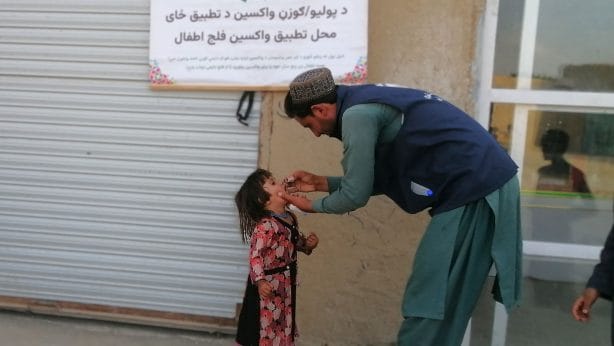
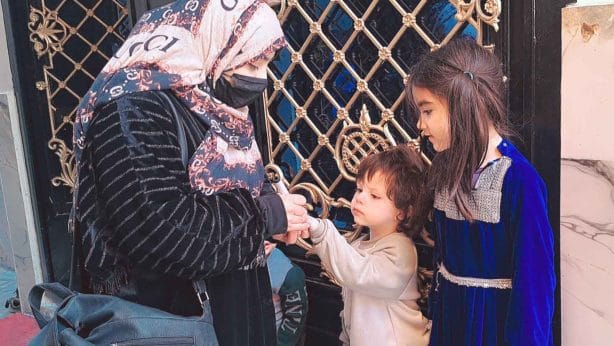
 Children receiving polio vaccines in the Pitak area of the Farajghan Valley, Laghman province. © Polio Free Afghanistan / 2026
From awareness to trust
What began in a single household gradually reached every home in the village. Concerns gave way to understanding, doubts faded, and awareness took root.
The village’s tribal elder, Khanullah, says, “We had never even heard of polio before, but Abdul Baqi showed us how dangerous the disease is and how vital vaccination is in preventing it.”
He adds that once trust is established, change follows quickly. Today, families bring their children for vaccination willingly, having come to understand that these two drops are a guarantee of a child’s healthy life.
Dialogue over doubt, trust over fear
Still, some families continue to have concerns due to misinformation and rumors. Abdul Baqi listens to their concerns, answers their questions, and works to find a way to reach every child.
In this regard, religious leaders also play an important role. The village mosque’s imam, Mawlawi Ismail, says, “Protecting children is a demand of faith, reason, and conscience.”
He stresses that children’s health must not be sacrificed to rumors and misinformation.
 Abdul Baqi has been working as a polio vaccination campaign coordinator in his community for the past four years. © Polio Free Afghanistan / 2026
Every child matters
Abdul Baqi believes that protecting a single child means protecting the future of an entire community. “If even one child is saved from polio,” he says, “our efforts have not been in vain.”
In his view, if every child receives their rightful protection and none are left unvaccinated because of doubt, ignorance, or neglect, polio can be eliminated from Afghanistan once and for all.
The struggle continues, carried forward by hope. This is the story of frontline workers in the battle against polio who travel long distances, endure hardships, and build trust so that every child has a chance at a healthy life.
Because when a child is vaccinated, it is not only the child who is protected from disease; an entire community takes a step toward a safer future.