
A trek for health in the cradle of the mountains: Working toward a safe future for Panjshir’s children
Abdul Mahfooz Rezaei, 46, originally Panjshir’s Shotul district, has devoted his career to protecting children’s health and eradicating polio, putting years of professional training and field experience to work.
Panjshir, Afghanistan - Life in Panjshir’s rugged peaks and valleys demands particular care and fortitude. Yet in the foothills of those same mountains, the life of 46-year-old Abdul Mahfooz Rezaei stands out as a story of endurance and persistence.
His childhood was spent in hardship and suffering. Those years robbed him, as they did thousands of other children, of any chance at regular schooling.
Adversity, however, never broke his resolve. Through relentless effort, Rezaei finished high school and went on to complete a two-year professional program in medical sciences, so he could serve his community as a trained health worker.
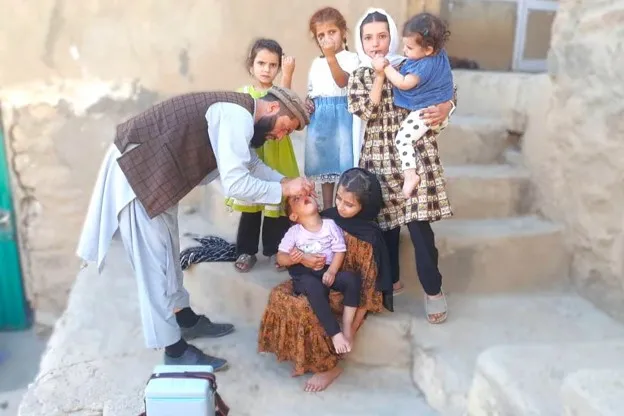
Today, he puts that knowledge and experience into practice. Working as a monitor for local polio vaccination campaigns, Rezaei treks along mountain trails that snow and punishing terrain make hard to travel. But his goal is clear: no child should go without this lifesaving vaccine.
An encounter that changed the course of his life
One memory from Rezaei’s career reshaped everything about how he works. While making his rounds in his home district, he met a family whose child had been permanently paralyzed by polio. The parents clung to the hope that their son might one day walk again, but poverty and other hardships had worn them down.
When Rezaei told the family that polio paralysis is permanent and incurable, whatever hope they had collapsed. For a family already struggling to survive, caring for a paralyzed child places an overwhelming physical and financial burden on the entire household.
The memory stayed with him. Poverty was devastating on its own, he realized, but paired with a preventable disability, it can strain a family to its core. From then on, his work was no longer just a job. It became a promise that no family should endure this pain.
© Polio Free Afghanistan | 2026
Abdul Mahfooz Rezaei administers the polio vaccine to a child in the mountains of Panjshir.
A new phase in field monitoring and professional duty
Rezaei’s days now run from eight in the morning until four in the afternoon, spent on the mountain trails. During each campaign, he covers about 60 households and 120 children, and he closely monitors and evaluates the work of 24 vaccination teams.
But his job is more than numbers and reports. He checks vaccine storage temperatures with great care, flags problems in the field as they arise, and uses his visits to track down children who missed the vaccine because of family indifference or limited awareness.
Overcoming doubts through trusted community leaders
In remote areas, clearing away people’s doubts and misconceptions about vaccines is not easy work. Experience has taught Rezaei that ordinary persuasion is not enough. He needs the backing of respected figures the community already trusts.
During one campaign, a family refused the vaccine. Rezaei did not sit back and give up. He went looking for a solution right away and took the matter to the village’s religious scholar and a local doctor. Hearing those trusted voices and their arguments, the family agreed to have their children vaccinated. It was a clear demonstration of how close cooperation between frontline health workers and local leaders can break down even the most deep-seated doubts.
© Polio Free Afghanistan | 2026
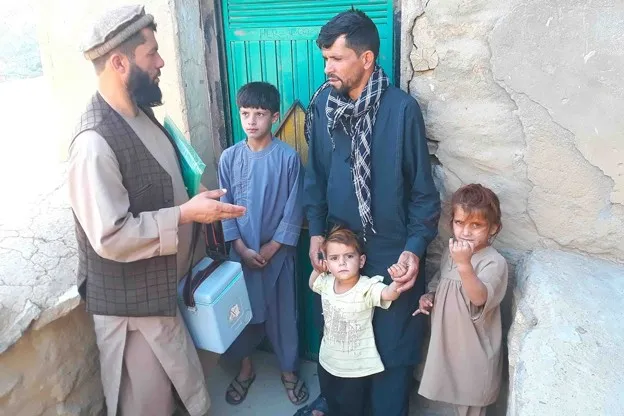
Abdul Mahfooz speaks with the head of a household about vaccination and essential health practices.
Beyond polio: A broader vision for public health
Rezaei’s work doesn’t stop at polio. Drawing on his medical training, he uses his home visits to open up wider conversations about family health, guiding parents through routine childhood immunizations, maternal health (including tetanus and diphtheria, or Td, shots) and hygiene.
He also advises families on washing their hands with soap, using clean water and looking after their surroundings. And he answers their questions and worries about vaccine safety and benefits with patience, so that rumors and misconceptions don’t take hold.
Family support and a big hope for the future
At first, even Rezaei’s own family didn’t fully grasp the value of his work. Then they saw the good it was doing across the community, and they stood firmly behind him. Today his mother, father, wife, brothers and sisters are all proud of what he does.
His greatest hope is to see the day Afghanistan is free of the poliovirus. "My biggest wish is that one day Afghanistan will be free of polio and no child will be disabled by this disease," he says. "When I remember the child in my area who was paralyzed by polio, I push myself harder to keep going. I don’t want other families to go through that pain. The day our country is free of polio will be the happiest moment of my life, and for all my colleagues who work to protect children’s health."