A quiet yet impactful fight against polio in Chaparhar
Nangarhar, Afghanistan – Polio remains a serious threat to the health of children in Afghanistan. Every year, numerous children contract this preventable disease, and some are left with lifelong paralysis.
This reality inspires some individuals to demonstrate their commitment not only in words but through action—remaining steadfast on the frontlines in the fight against polio.
Dr. Khalil-ul-Haq Hashimi is one of these quiet yet highly impactful fighters, someone who has made the prevention of polio in the remote villages of Chaparhar District in Nangarhar not just his job, but a national and humanitarian responsibility.
He began working as a volunteer in polio vaccination campaigns around nine years ago.
“At that time, there was a great deal of skepticism about the vaccine, and in some areas, family elders would not allow their children to be vaccinated,” he says. “But through continuous awareness and engagement efforts, we were gradually able to build people’s trust.”
He now leads vaccination campaigns as the supervisor of Cluster 13, coordinating the work of dozens of teams.
What distinguishes Dr. Khalil-ul-Haq’s work is that he does not view polio as merely a health issue; in his view, the real challenge is low public awareness and mistrust among communities.
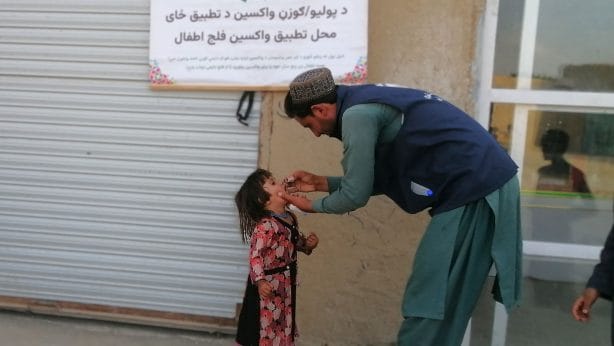
 Dr. Khalil-ul-Haq Hashimi administers the polio vaccine to a child using a jet injector in Chaparhar District. © Polio Free Afghanistan / 2025
“Success against polio cannot be achieved through vaccination alone; we must first overcome people’s lack of awareness and mistrust,” he says.
Based on this belief, Dr. Khalil-ul-Haq realized that to fight polio more effectively, people’s hearts must be won, and their trust must be earned.
That is why he considered gaining the support of religious scholars and community elders in Chaparhar District as the most crucial step, since they have a profound influence on people’s decisions and choices.
After extensive efforts in this area, he was able to build close relationships with religious scholars and community elders, turning them into strong allies in the fight against polio.
Among them is a religious scholar named Mawlawi Ismail, who understands the dangers of polio and the benefits of vaccination. He says that protecting children’s health is one of the key responsibilities emphasized by religion.
“Polio is a disease that can leave a child disabled for life, so no child should miss vaccination due to negligence,” he adds.
He emphasizes that vaccination is a legitimate means of protecting children, and families should vaccinate their children without delay and support the health teams in their efforts.
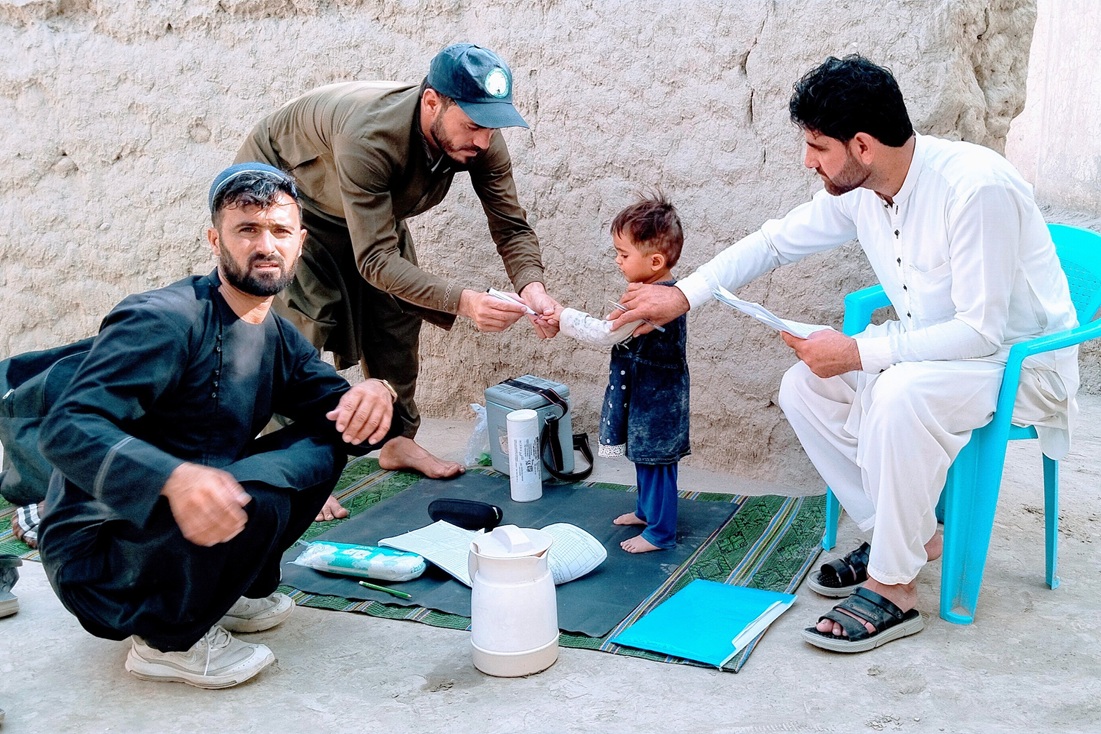
 Dr. Khalil-ul-Haq Hashimi reviews the list of vaccinated children during the polio vaccination campaign. © Polio Free Afghanistan / 2025
Alongside religious scholars, community elders in the area now also play a vital role in strengthening acceptance of vaccination. One of the local elders, Mohammad Ayub Khan, says: “It is the right of our children to grow up healthy and safe. We will not allow any child to miss vaccination because of false rumors or doubts.”
As a result of this united stance by religious and community leaders, many families now vaccinate their children regularly.
But for Dr. Khalil-ul-Haq, the work does not end with just convincing people; he strives to ensure that no child misses vaccination because of doubt, fear, or negligence. At times, he encounters situations that make the true meaning of this struggle even clearer.
He recalls a moment when a father brought his disabled child to him. The father’s voice trembled and his eyes were filled with tears. “For years, I refused vaccination,” he said. “Now I realize how heavy the price of that negligence truly is.”
According to Dr. Khalil-ul-Haq, such words are both painful and awakening for him.
“When someone witnesses the irreversible effects of polio up close,” he says, “they no longer just perform a duty; they feel a deep sense of responsibility. That is why, in every campaign, we spend long hours talking with people, listening to their questions, taking their concerns seriously, and working to build trust with every family.”
He emphasizes that convincing families is not the work of a single day: “Some families do not say yes, the first time. But if you approach them with respect, stand with patience, and remain engaged with them consistently, they are the ones who eventually come to you and ask, ‘When is the polio vaccination team coming?'”
The experience in Chaparhar shows that preventing polio is not merely a technical process of administering vaccines; it is a social journey of building trust, encouraging community participation, and embracing shared responsibility. Until all families confidently say “yes” to vaccination, some children will continue to be deprived of this right because of doubts and misinformation. Yet even that one child remains the true focus and ultimate goal of all these efforts.
Dr. Khalil-ul-Haq says: “We work for the safe future of every child. Even if just one child is protected, our efforts are not in vain.”
Today in Chaparhar, the united stance of religious scholars, community elders, and health teams carries a clear message for families: “Polio is a preventable disease, but prevention is only possible when every child is vaccinated on time, and no family allows doubt or misinformation to deprive their child of this right.”