Visible change against an invisible threat
How a group of young people in Laghman reshaped attitudes toward polio vaccination
Laghman, Afghanistan – In areas where mountains stretch the distance between villages and information travels slowly, some threats remain hidden in silence. Polio is one of those threats, a disease with no cure, yet entirely preventable.
The virus enters the body through contaminated water and food and, in some cases, can take away a child’s ability to move within just hours, often for life. The challenge is that many children show no symptoms until the disease suddenly reveals its devastating impact.
In such areas, the goal of public health efforts is not only to administer vaccines but also to change perceptions about how polio spreads, the harm it causes, and why vaccinating every child is essential.
In a Pashai community in Alishing district of Laghman, this change has gradually taken shape through sustained efforts.
Azizullah Azizi, who began working as a volunteer in polio vaccination campaigns around 13 years ago and now serves as a supervisor of vaccination teams, has played a key role in building trust within his community and raising awareness.
“In the past, we thought that as long as the vaccine reached every household, that would be enough,” he says. “But when campaigns began, some children were still being missed.”
He adds that it was then that he realized that, alongside administering vaccines, raising awareness and engaging with families were essential to ensure that no child is left unvaccinated.
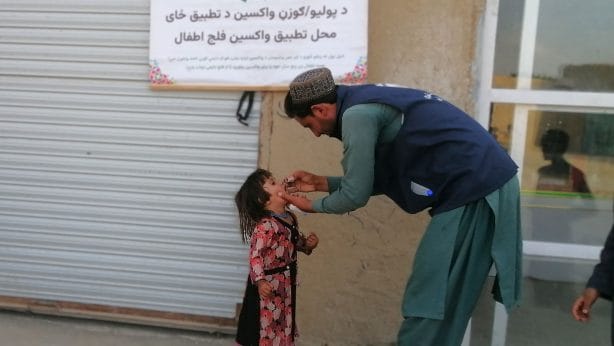
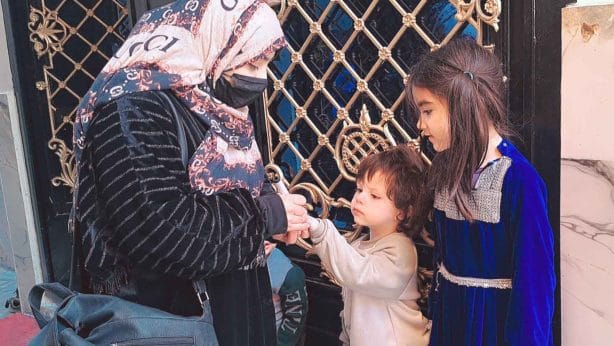
 A child receives the polio vaccine in the presence of family members in Laghman © Polio Free Afghanistan / 2026
A hidden threat that changes lives
Polio often shows no symptoms. A child may appear healthy, yet the virus can strike suddenly. According to global data, one in every 200 infected children is permanently paralyzed.
This invisibility makes the disease even more dangerous.
Azizullah says, “When people do not see the risk, they do not act.”
To address this challenge, Azizullah and his team changed their approach. Instead of waiting for campaign days, they began engaging with families in advance, speaking with them directly and raising awareness.
They made a deliberate effort to explain this hidden threat in the Pashai language, using simple, everyday examples that resonated with people’s daily lives.
“In our meetings with community elders, we explained how children can become paralyzed by polio, why they need to receive the vaccine during every campaign, and that the risk is not always visible, but it is always present,” he adds.
This was not just about sharing information; it was about shifting mindsets and changing perceptions.
“We were not only providing information but also trying to help people understand and truly feel the risk,” says Azizullah. “Once people developed that understanding, they began bringing their children for vaccination themselves.”
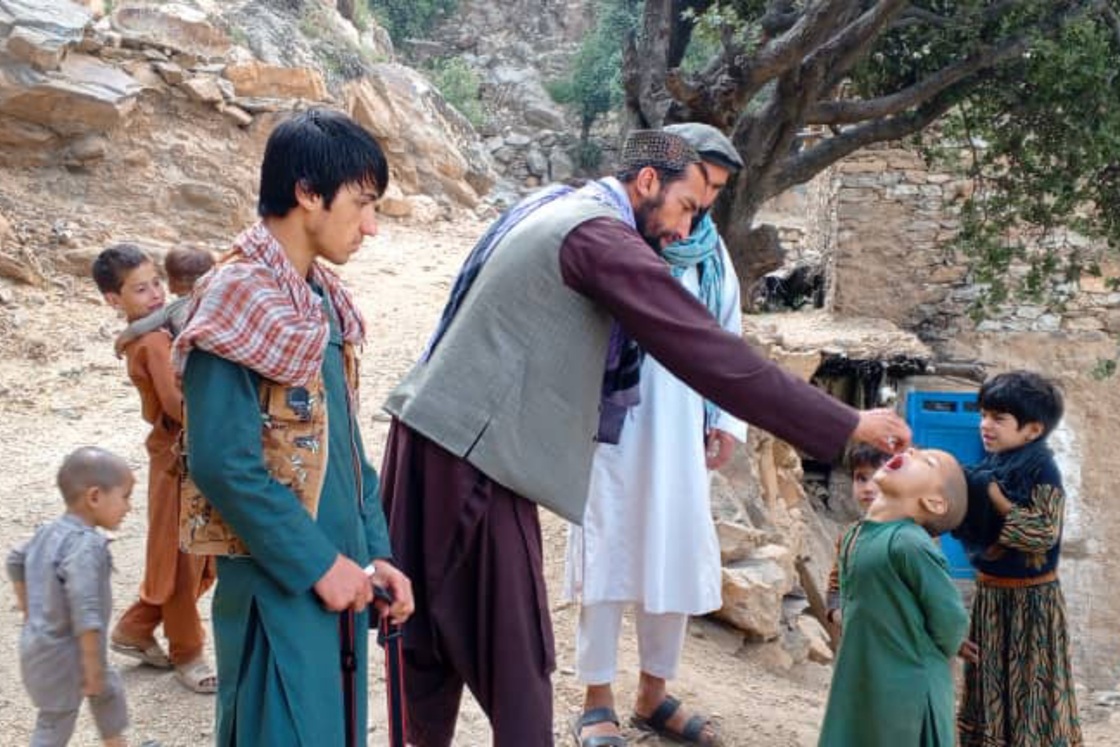
 A volunteer administers polio vaccine to children in Alishing district © Polio Free Afghanistan / 2026
Gradual change, lasting impact
Although this change took place gradually, its impact has been deep and lasting.
Now, when polio vaccination teams arrive in the area during campaign days, a single announcement is enough for families to bring their children for vaccination.
Ahmad, a resident of the village, says, “In the past, I believed that if a child appeared healthy, there was no need for vaccination. But now I understand that while the risk may not always be visible, it exists, and vaccination can prevent it.”
Beyond the numbers
Wahidullah, a public health expert, says, “In public health, the most difficult task is convincing people to act against an invisible threat. Once that happens, everything else becomes easier.”
In this area, acceptance of vaccination has increased. More importantly, vaccination is no longer seen as optional, but as an essential part of protecting children.
Hakim Khan, the village imam, also supports this shift and says, “We always tell people that a child’s health is everyone’s responsibility. When families understand this, they no longer delay vaccination.”
At the end of the day, Azizullah does not only look at numbers. He measures how much people have come to understand, because in his view, it is this understanding that makes change last.
In areas where polio remains a threat, this experience offers an important lesson: the solution lies not only in delivering services, but in building awareness and deepening understanding.
Perhaps that is the core message: when an invisible threat is made visible to people, change finds its own way.