Abdul Wahab and His Three-Decade Fight Against Polio

Logar, Afghanistan – Amid Afghanistan’s many challenges, one of the most pressing remains polio, a disease that continues to threaten the lives of children.
This disease, which causes paralysis and can even lead to death in children, has been eradicated in most countries around the world. Yet it still persists in our country, and a wide-scale fight is being carried out to prevent it.
Among the many unsung heroes of this fight is Abdul Wahab, who for the past three decades has stood on the frontlines, working tirelessly to protect children from polio.
Beginning of Service
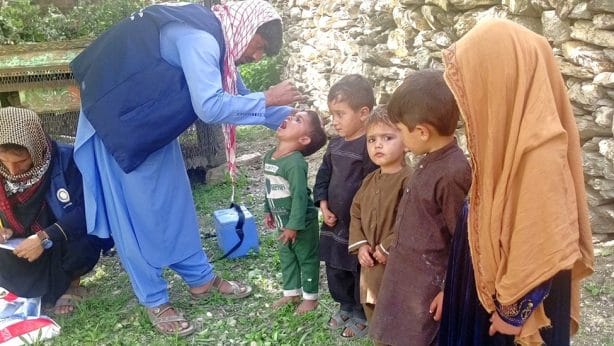
Abdul Wahab entered the fight against polio in 1993. At that time, Mohammad Agha district of Logar — like much of the country — was gripped by the waves of conflict. Many health centers were closed, and people’s trust in vaccination was either very weak or nonexistent.
At that time, he began his work as a vaccinator, and the first days were full of challenges, as many people, driven by mistrust, refused to vaccinate their children, while insecurity in the area further complicated the efforts of vaccination teams.
But Abdul Wahab had decided that he would face the challenges and continue his important duty.
“I devoted much of my time to helping those children who, due to a small act of neglect, could contract polio and be paralyzed for life,” he says. “For me, this was not just a duty, but both a humanitarian and religious obligation — and it still is.”
 Abdul Wahab vaccinating children in Mohammad Agha district of Logar © Polio Free Afghanistan / 2025
Stages of Change
Over the course of his long struggle, Abdul Wahab has not only delivered polio vaccines to children but has also shared his experience and skills with his fellow colleagues.
After working as a volunteer and vaccinator, he now serves as a coordinator for polio vaccination campaigns in his area.
In this role, he develops vaccination campaign plans for villages and districts, leads and supervises teams, builds relationships with tribal leaders, and trains new vaccinators.
Over the past three decades, Abdul Wahab has faced many obstacles and challenges. At times, insecurity prevented vaccination teams from traveling. At other times, people’s mistrust kept children from being immunized. Harsh winters and scorching summers also became barriers along the way. Yet despite it all, he never lost his determination or commitment.
“For me, no fatigue or obstacle ever compared to the moment when a child is saved from lifelong paralysis.”
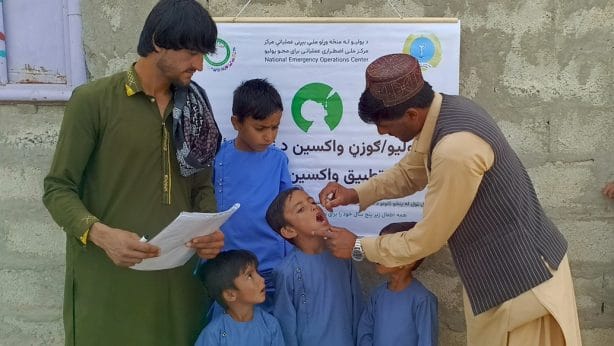
 Abdul Wahab monitoring a polio vaccination campaign © Polio Free Afghanistan / 2025
Community Trust and Support
Today, Abdul Wahab is a pillar of trust for the people of his community, and both village elders and religious scholars commend his efforts.
A religious scholar from Logar, Mullah Abdul Rahman, says: “Islam places great emphasis on saving human life. To save the life of one person is as if to save all of humanity. Abdul Wahab works on the basis of these teachings, protecting the future of thousands of children.”
A doctor at the local hospital, Dr. Basir Ahmad Hakimi, says: “Polio is an incurable disease, and the only means of prevention is vaccination. Without dedicated people like Abdul Wahab, our fight would never be complete.”
Inspiration for the Family
Through his character, Abdul Wahab has also taught his family the value of service to the community.
His son, now a school student, proudly says: “I draw inspiration from my father’s work. When I see him not giving up in the face of hardship and striving to save others, I too want to become a useful person for my community in the future.”
 Abdul Wahab trains volunteers before the campaign © Polio Free Afghanistan / 2025
Hope for the Future
The fight against polio is still ongoing, but heroes like Abdul Wahab are a strong source of hope for its success. For him, every obstacle is only temporary, while a few drops of vaccine are a guarantee for safeguarding the future of an entire community.
He emphasizes: “My hope is that one day Afghanistan will be completely free from the threat of polio. Every drop we give to a child opens a new door for their life.”
Abdul Wahab’s story shows us how the sincerity and perseverance of one person can change the lives of thousands of children. His fight is a struggle to safeguard future generations.
In his three-decade struggle, Abdul Wahab has proven that change always begins with one person — a change that starts with a single drop of vaccine, but results in lifelong health for children and a hopeful future for the community.