
The grief that hardened into resolve: Haji Mohammad’s fight against polio in Paktika
For the past seven years, 33-year-old Haji Mohammad, a volunteer in Paktika's Yousuf Khel district, has been vaccinating children, winning the trust of families and raising public awareness. His goal is to shield the children of his community from lifelong paralysis and make sure no family ever must watch their child grow up with a disability.
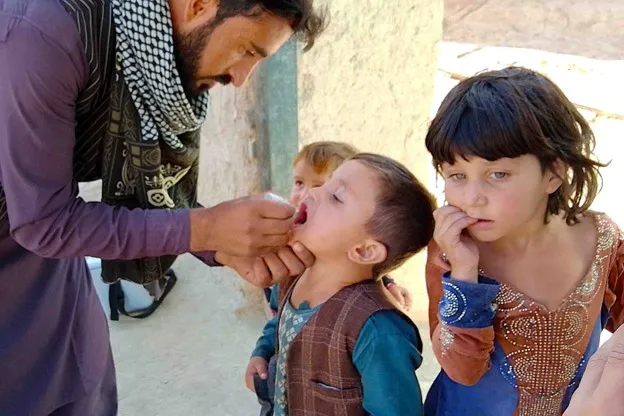
Paktika, Afghanistan - Along a wide, dusty street in Paktika’s Yousuf Khel district, lined on both sides by tall mud walls, a crowd of children has gathered around a polio volunteer.
Hardship and poverty are plainly visible on the children’s small, innocent faces, yet hope for life and the future still shines in their eyes.
In the crush, a young boy cradles his little sister in his arms, waiting eagerly for his turn so she can receive two drops of the polio vaccine.
It looks like an ordinary scene, but behind it lies a far larger, urgent story about children’s health and the fight against polio.
The volunteer at the center of the crowd is 33-year-old Haji Mohammad, who has spent seven years working in this area for the health and safe future of its children.
His work, and that of his colleagues, goes beyond just administering two drops of the vaccine. It means winning over hesitant families, helping people understand the value of immunization, and tracking down every child who, for any reason, has missed out on this lifesaving service.
A bitter memory and a lasting lesson
Across his seven years as a volunteer, Haji Mohammad has seen plenty of highs and lows. But one incident remains etched in his memory, one he says he will never forget.
He recalls when a family had recently returned home from displacement: "During every polio campaign, I went to their house and tried to explain the dangers of the disease and why immunization mattered," he says. "Unfortunately, they remained unconvinced and would not allow their children to be vaccinated."
Three years passed. When Haji Mohammad returned to the same neighborhood, he was met with a devastating sight that would stay with him for the rest of his life.
Two children in the family had been afflicted by polio, cases that had not even been officially recorded.
The very outcome he had fought to prevent years earlier was now playing out before his eyes. The sight of those two children drove home the stakes of his mission, hardening his resolve to ensure no other child in the community falls victim to the same fate.
© Polio Free Afghanistan | 2026
Haji Mohammad vaccinates a child in Paktika’s Yousuf Khel district as other children wait their turn.
Turning to community service after studies
In Yousuf Khel, where unemployment, past conflicts, and displacement have battered everyday life, educated young people are rare.
When Haji Mohammad graduated from high school, there were no opportunities for higher education in the area. Around that time, a close friend, Najibullah, who was already working in polio prevention, pointed out how few educated people the area had and urged him to help safeguard the health of their community’s children.
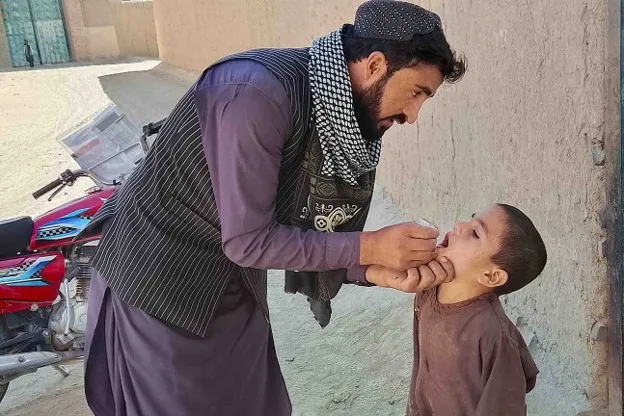
Haji Mohammad agreed and began working as a volunteer. Today, during each campaign, he vaccinates between 220 and 230 children a day in his area.
Yet the work, he emphasizes, cannot be measured in numbers alone. Building relationships with families, sharing clear information, and listening to people’s questions and concerns matter most.
"Every time a child receives their drops, I feel a deep, genuine joy," he says, "because I know I have done my part to protect their health and secure their future."
The challenges of raising awareness and the need for shared responsibility
Reaching people in remote rural communities with health messages and winning their trust is no easy task, as some families still refuse to have their children vaccinated. In Haji Mohammad’s view, simply asking them to vaccinate their children on campaign days will not suffice. It demands sitting with them, listening closely to their fears, and dispelling doubts with accurate, clear health information.
He views tribal elders and religious scholars as vital voices in changing public attitudes, and he hopes their support for this national effort will grow even wider.
"Sometimes, people in the community assume that these activities are simply the volunteers’ personal responsibility and that we only do it for the pay or some benefit," he explains. "Because of that misconception, some tribal leaders and clerics don’t cooperate as much as they should. But protecting children from polio is a shared responsibility, and it belongs to parents, health workers, tribal elders, religious scholars and every member of the community."
In his view, stronger public awareness, a greater sense of shared responsibility and the active support of influential community members for vaccination campaigns could bring about positive and lasting changes in how families think about immunization.
© Polio Free Afghanistan | 2026
From house to house and street to street, Haji Mohammad works for the healthy future of children in Paktika.
A polio-free Afghanistan: one great hope
Haji Mohammad urges parents to take their children’s health seriously and have them vaccinated in every campaign. "Parents should share their questions and worries with health workers and follow their guidance,” he says, “because the vaccine is the only and most important way to protect children."
Behind his nearly seven years of volunteer service lies one great hope: to witness the day when Afghanistan is completely free of the poliovirus.
With a smile, he adds that seeing his country free of the disease would be the greatest joy of his life, the moment he would know his deepest hope had been realized.