
The teacher that turned his classroom into a center for learning and polio awareness
In Ghazni, 37-year-old teacher Abdul Samad, whose right arm and leg were paralyzed by polio in childhood, struggles on foot for an hour every day despite his disability to reach the children of his village and teach them; alongside everyday lessons, he teaches his students about the dangers of polio and the value of vaccination, so they will carry that lifesaving message home to their families.
Ghazni, Afghanistan - Along the dirt roads of Giro district in Ghazni province, a man’s footsteps echo every morning, each step carrying pain, endurance and resolve. This is Abdul Samad, a 37-year-old teacher whose right side was paralyzed by polio, yet whose will remains strong and unbreakable.
Unable to ride a bicycle or motorbike, and without the means to travel by car, Abdul Samad walks an hour every day from his home to school. His destination is Shaheed Asadullah Khadim High School in Bator village, where for the past decade he has brought the light of learning to local children.
The moment he steps into the classroom, the exhaustion of the journey melts away. Though rainwater has streaked the whitewashed walls gray and the children sit on worn mats, hope for the future stirs in their eyes during the lesson. Abdul Samad knows that the old mats and stained walls can one day be renewed, but the parts of his body struck by polio will never heal.
The heavy price of limited access and awareness
The story of Abdul Samad’s disability began some three and a half decades ago, when he was just nine months old. At the time, access to healthcare in rural areas was scarce, and awareness of vaccines was virtually nonexistent.
Recounting what his family told him, Abdul Samad says: "Until I was nine months old, I was completely healthy, when suddenly my right arm and leg stopped moving. My family thought it was just an ordinary, passing illness."
With no medical knowledge or health facilities within reach, his parents turned to the shrines of Ghazni instead of seeking medical treatment. They hoped prayers and spiritual blessings would heal their son, but the poliovirus had already taken its toll, forever binding Abdul Samad’s childhood dreams to physical limitations.
© Polio Free Afghanistan | 2026
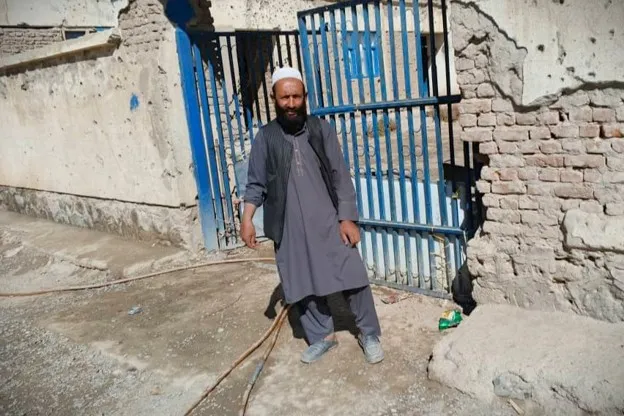
Teacher Abdul Samad arrives at his school in Ghazni’s Giro district after an hour-long walk. Polio paralyzed the right side of his body, but the physical disability has never stood in the way of his efforts to educate children and fight the disease.
Education: the only way to overcome limitations
Though Abdul Samad’s family struggled with severe financial hardship, they refused to let their son’s physical disability stand in the way of his intellectual growth. He went to school, continued his studies through a teacher training college, and ultimately dedicated himself to serving his community in the classroom.
Now a father of six, he sees his disability not as an obstacle, but as a source of motivation.
"Whenever the long walk leaves me exhausted and drained, the future of my children and students rises before my eyes," he says. "I always try to ensure my children never feel as though their father’s disability has held back their progress and education."
At school, the students’ respect and the administration’s support give him even more strength. On days when physical difficulties prevent Abdul Samad from making the journey, the school administration steps in to cover his classes so the children's lessons never fall behind.
© Polio Free Afghanistan | 2026
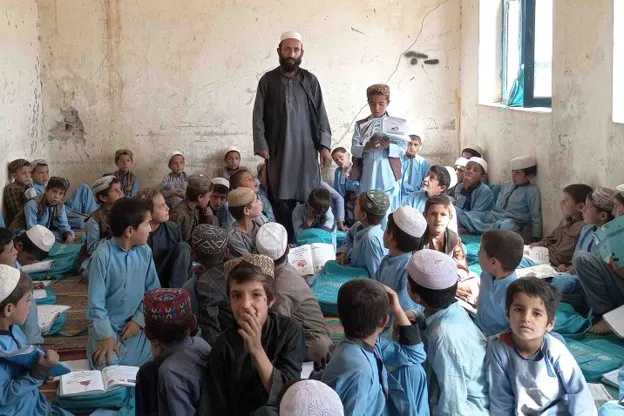
Abdul Samad stands in his classroom, listening as a student reads aloud from a book. For the past decade, he has taught children in this modest classroom, working to ensure no child suffers physical disability from polio as he did, or is deprived of an education.
From classroom to home: carrying the message against polio
For Abdul Samad, a teacher’s duty goes far beyond the pages of a textbook; he uses his classroom as a center for spreading awareness. Alongside daily lessons, he informs his students about the dangers of polio and the value of vaccination, so that they not only understand it themselves but carry the message home and share it with their mothers and fathers.
Having lived with the toll of polio himself, Abdul Samad knows all too well how bitter life becomes for a child who is both paralyzed and deprived of an education.
"If I had received the polio vaccine as a child, my arm and leg would not be paralyzed today, and I would have reached all my dreams," he says. "I don’t want any other child to go through the pain I bear every day."
In rural areas, doubts and misconceptions still lead some families to refuse vaccination for their children. Whenever health workers encounter hesitant families during vaccination campaigns, Abdul Samad steps in to help outside the classroom too. He sits down with the villagers, shares his own experience, and convinces them to safeguard their children’s future with two drops of vaccine.
Abdul Samad’s greatest dream is to see Afghanistan completely free of polio, a country where no child loses the ability to move, the chance to play, or precious opportunities to learn because the vaccine never reached them.